Showing posts with label Knight's Cross. Show all posts

Tuesday, 5 July 2016

The German Iron Cross, a listing of 2nd class Variation's


With the war being declared in September of, it is believed that several medal manufacturers were in fact caught out with the re- institution of the Iron Cross and as such, many variations were manufactured until a standardisation came in about 1940/41. These variations are highly collected by the Iron Cross collector and much discussion has been raised on them. The Iron Cross is Germany's top Bravery award, like Great Britain's Victoria Cross. This award -namely the Knights Cross of the Iron Cross- went on to capture the imagination of the German People and later, the World. Unlike Great Britain though, who has different bravery awards for different ranks, such as the Military Cross or Distinguished Flying Cross for Officers or the Military Medals or Distinguished flying medal for Other Ranks or NCOs’. The Iron Cross came in four grades (at the beginning of the War), being the Iron Cross 2nd Class for one act of bravery, the Iron Cross 1st Class for 4 or more acts of bravery, the Knights Cross of the Iron Cross, four outstanding act of bravery and the Grand Cross of the Iron Cross (only awarded once in World War two to Hermann Goring The Reichmarchell of the Luftwaffe). There were also two bars, one for the 2nd class ribbon of the Iron Cross 2nd class 1914, for those awarded the decoration in World War two, and a pin on "bar" that was worn over the Iron Cross 1st Class for 1914, if again the holder was awarded the decoration in World War two, this "Bar" was an opened winged eagle holding a swastika over a dated bar of 1939. Here though, we are going to be looking at the first of these awards and their variations. 

 Iron Cross

The first variant we shall discuss is the oversized Iron Cross. These measure anything from 47 mm to 48 ½ mm and it was believed that these were to be the new "Knights Cross" of Germany's newly instituted Iron Cross series. These crosses appear to have been manufactured by one or two firms, as very few of the centres show any difference in die characteristics. 
 Knights Cross


The next type of variation is often called the Schinkel form. These are usually crosses that have been manufactured from parts utilised from WWI crosses being the frames but with newly made centres. Several of these were non magnetic and some have even been of one piece construction. To date, only one of these crosses has been encountered with a maker's mark although it would appear that several manufacturers’s made them. With these Schinkel crosses, you also get variations in the size of the swastikas and size of the dates as well as stylisation of the numerals and frame variations.

Then comes a type called the straight arm cross or the Shinkel form type B. This is in fact more like the original design by Karl Friedrich Schinkel. One variation of this cross has a rounded No "3" which leads us onto the next type that is like the standard type but with this type of numeral configuration. For ease many call it the rounded "3" type because it has the top part of the three rounded instead of flat like the standard type of crosses. And like all of the above this type can be found in first class as well as the


Occasionally you may find a Non Iron cross that has a zinc or brass centre, these are usually the standard form but you will find as stated early the type a Schinkel with this feature. Also on the standard crosses you will find a verity of makers marks stamped into the ribbon ring but on rare occasions you may find it marked on the crosses frame like this L/12 example. 


Finally there are the one piece made examples that come in a number of metals ranging from nickle silver to zinc, But be very careful with these as they have been heavily copied On a rather sad note, these crosses have now been reproduced both in the first and second class forms in both the standard pattern types and the schinkel type a patterns and care must now be exercised with these crosses. On the first class Shinkel types, several reproductions have been seen with their pins marked 800 and Godet, whereas the second class crosses have had their rings stamped with post 1941 marks, again a practice that would not have been encountered on them.… 

To our knowledge, none of the other styles have been copied, but we feel this is only a matter of time, with many collectors of the Iron Cross wanting to fill the gaps in their collection after the release of the excellent book "The German Iron Cross" by Gordon Williamson. This has not only spurred on collectors, but also the repro manufacturer's to take their art to newer forms. So what were once considered to be safe purchases must, like the rest of our hobby, be scrutinised.


The firm of Jamie Cross is Non-political & items offered for sale are for historical interest and investment only. We have a nice collection of German War Medals, British Army Medals and British Medals for Sale.

Monday, 6 June 2016

The Cholm Arm Shield 1942

 German War medals
As many readers of the Armourer will know, we have been doing a series of articles for beginners, in collecting German War medals of the Third Reich. I now feel it is the right time to cover some of the rarer and elusive items that can be acquired with research, patience and diligence. 

The German armed forces with her allies, under the direction of Adolf Hitler, had invaded Russia in Operation Barbarrosa. Unfortunately for the troops involved, this was the road to four years of bitter fighting and then for those who survived, several more years of brutal Soviet captivity. In the early years however, it seemed that Germany was unstoppable. The Russian  armies were quickly surrounded and annihilated in the first few months of the invasion. It was only when winter came that the German armies were stopped. Ill prepared for this cold season, it was the ideal time for the Russians to launch their counter offensive. This they did in the first week of December 1941, when Marshall Zhukov launched "Operation Typhoon" and with the  combination of appalling bad weather and lack of winter equipment, they pushed the invading German army back from the gates of Moscow.

In the North of Russia, on the Southern Flank of Army Group North, the German 16th Army reeled under this hammer blow, conceding ground, but still hanging onto the two main routes through the swamps, covering the area between the lakes of Seeliger and Ilmen. These routes ran through the towns of "Cholm" and "Demjansk". Here the German Army dug in and awaited adequate warm clothing and fresh supplies. Hitler had given orders that there was to be no retreat and as such, these garrisons or fortress towns were to be established. 

In Cholm, (which is in the Kalinin region of Russia, located on the Lovat River), Battle Group Scherer was formed with approximately 5500 men, isolated, outnumbered, and surrounded. These men managed to hold out for several months (In total 105 days), and this small force withstood over 100 infantry attacks with 42 of these being supported by tanks, by a superior 
Russian force, which is more remarkable when you know that many of these troops were not combat units, rather supply or transport units like a Naval unit. 

Finally in the Spring, the garrison was relieved, but only about 1,200 of the original 5500 survived intact. Throughout the ordeal, the besieged troops were supplied by air with some of the wounded being flown out. During heavy attack and in the absence of heavy weapons, this small pocket was supported by artillery fire 10 miles away in the main German lines. 

Following this epic battle, Major General Theodor Scherer was awarded a 
Knight's Cross and his men were given a battle shield. 

The Cholm shield was instituted on 1/7/42 and was for any member of the armed forces who served in a single, or all, military units between 21/1-5/5/42. 

Entitlement was also open to those troups who were killed or wounded in action and for the airforce and navy personnel who assisted in evacuation of the said wounded. 
This is the rarest official shield to be instituted, as less than 5500 soldiers would have been eligible and most of them would have perished in Russia. 

Award documents were signed by General Major Scherer who was the fortress Commander. 
Bestowal for these awards ceased on 1/4/43, with the only exception being for the men who were MIA or POW`s. 

 Knight's Cross
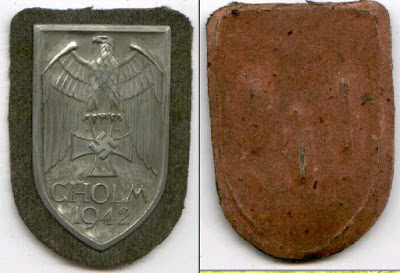
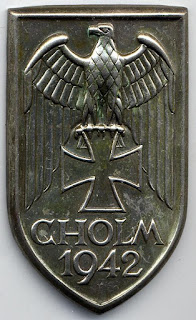
The shield design itself is very striking and powerful looking and consists of a shield shaped stamped metal, flat topped award which resembles a knight's shield in shape. The main design is a wehrmacht eagle holding an Iron Cross with a swastika and below this is the word "CHOLM" and the date "1942" under the word. There are two main types of lettering the longer "M" and 
the Shorter "M". So far, all shields that have been examined by us have been of pressed metal construction, either of magnetic metal or fine zinc. They appear to have a combination of the number of pins and also their positions ranging from 2 to 4 affixed on the back. This in turn passes through a backing cloth whose colour can range from basic army green being the most 
common, to luftwaffe, then navy and panzer. There is speculation as to the two different types of backing shape, one type follows the design of the shield, whereas another is a long oval shape. One person has put forward the theory that the long oval shape types in steel were the first to be issued and the zinc ones were replacements. Personally, I discount this theory as we 
have found combinations of both types on both backings. 

With regards to copies, we have seen several different types from solid metal castings, to good quality stampings. These have all been in the wrong type of metal. Also there are major differences between the styles of the eagle's head on the originals to the reproductions. 

With the re-institution of the 1957 awards, this award was sanctioned. The only design change is the omission of the swastika. The award was only worn on a ribbon bar and the shield itself was sold as a commemoration piece. 

Prices: 

To date, you should expect to pay at least £1450.00 for a good example of a Cholm Shield on army green backing and add an extra £50.00 for luftwaffe and £150.00 for navy/panzer issue, both steel or zinc.